They've finally hit 4,000 US troops killed in Iraq. This is on top of the over 1 million dead Iraqis, millions of displaced Iraqis, and literally uncounted killed private military contractors.
Now, maybe more than a quarter of Americans will be able to correctly identify the number of Americans troops killed.
And then we have Bush saying that these deaths will not have been in vain (so we must stay in indefinitely), and Cheney "supporting" the troops by explaining that they volunteered, so it's OK that they died.
Monday, March 24, 2008


Friday, March 21, 2008
yes we CAN!
We needn't kid ourselves: Barack Obama is the more likely Democratic candidate to win the nomination, and when he does so he is rather likely to win the general election as well, if only because there is such a strong backlash against Republicans. Now, CAN doesn't endorse any politician as a matter of policy, but in an election year it is impossible to be an activist and at the same time ignore the ramification of candidates - especially if one is an antiwar activist.
I wasn't deep in the antiwar scene in 2004, when Kerry was running. I was opposed to the war, of course - I had been from the get-go - but as a Junior in High School, I was simply an individual opposed to the war, not connected with any group. I supported Kerry for the same reason many did - because he wasn't George W. Bush, and because ANYONE was better than Bush.
Unfortunately, this trend was mirrored in the antiwar community. The movement died down to a simmer as the efforts of the politically minded were directed to expelling Bush & co. from office. The student antiwar movement also fell into a lull, proving quite disheartening to many members.
For the antiwar movement on the whole, this is becoming the case once again. MoveOn.org has endorsed Obama for the presidency, and has devoted its efforts to electing him, away from the antiwar movement. Many people, either believing the myth that the "surge" is working or simply trusting the Democrats to get us out of Iraq in 2009, have also dropped out of the antiwar movement. Protests this year - the 5th anniversary of the war - were markedly smaller than they were last year.
However, all this is counter intuitive. If we have learned anything from the 110th Congress, it's that the Democrats - brought into power by a strongly antiwar electorate - has refused to take the steps necessary to bring an end to the war. The Democrats do not, of course, bear sole responsibility for this failure of leadership - the Republicans and the Administration have stonewalled and vetoed every measure to bring the troops home - but the Democrats have also not used their considerable political capital or clout to stand up to the Administration (excluding the current admirable fight they are putting up over the FISA fight), not has the Democrat-controlled 110th Congress used it's power of the purse to cut funding for the war, forcing the President to withdraw troops.
However, 2008 is shaping up to be a different year than 2004. As I've already mentioned, the antiwar movement is definitely taking what seems to be a hiatus - going into it's election year lull. However, on the student front, the antiwar movement is really heating up. CAN is growing at an ever increasing rate, and after during incredibly successful (and incredibly powerful) Winter Soldier testimonies, Iraq Veterans Against the War had so many requests to join that their server couldn't handle the load. Additionally, groups like the RNC Welcoming Committee are gearing up to make sure the war remains in the public eye - and is brought home to average Americans - when the media descends on Minneapolis/St. Paul for the Republican National Convention. While the antiwar movement as a whole might be waning, the student and veteran resistance is on the rise, with little sign of abating.
Thus, the obvious question needs be asked: Why? In a year when the population as a whole cares less about the war than ever before, why is the youth movement picking up steam?
I attribute it to a number of different causes. First, we have had the past three years (since the last presidential election cycle) to build a solid movement. For many in CAN, myself included, the antiwar movement is our first experience with taking part in a movement, much less building one. Here in UIUC, we have already experienced the pitfalls and joys of building a chapter from scratch, and learning as we go. The process creates a very organic and, I hope, democratic structure, but it also takes a lot of work and time before it can get off the ground. In 2004, CAN was much younger than it is now, with much less experience. The antiwar movement in the 1960s was able to draw on the success of the Civil Rights struggle - the modern student antiwar movement has no such recently history from which to build from, and thus we must rely on our own initiative and ideas.
However, this is also a blessing in disguise. It is my firm belief that in a few short years, a number of critical crises will afflict this country, from the environment to renewable energy, from healthcare to education to social security. Each of these will require capable activists to organize the movements around them, and the important building that we do now in the antiwar movement can hopefully prove a useful framework for future student activists. This is the benefit, and the burden which we willingly shoulder, of being on the vanguard of a new generation of activists.
Which brings me to my second point. Why was there no prior movement from which the modern student antiwar movement could draw on? For this, I blame "Generation X", the generation that grew up in the 1980s. They rejected the protests of the previous generation, and are stereotypically thought of as the "Me" generation - more concerned with their own well being than with larger social issues.
This new generation, however, is slowly coming back around to the idea that students and citizens in general can change the world for the better, and that direct actions and protests are an effective way to bring about change. The cause of this change? Frankly, in recent years I think much credit goes to Barack Obama.
Many in the antiwar movement - myself included - disagree with Obama. While he may now claim that he will withdraw troops within 6 months, many people feel that this is simply a ploy to win over primary voters, who typically are thought 0f as firther left than the general populace. Many still in the antiwar movement expect him to change his tune if and when he becomes the nominee for the Democratic Party.
However, Obama does have a very powerful message. His speeches and message of hope resonate with the younger set, and his chant of "Yes, we can" has caught on and resonates across the country and through the packed venues where he delivers his speeches. This message - and his incredibly Kennedyesque charisma - has not only energized students and youth, but has also (possibly subconsciously) put the idea that students can change the world into the minds of the youth. This makes Obama supporters - many of them college students - prime candidates to take the next step and become activists. It is much easier to convince someone to join a movement if they are already coming from a framework that affirms their ability change the world.
As more students flock to Obama's camp, it should be the job of the student antiwar movement to actively court these individuals. As mentioned earlier, CAN supports no candidate, because we believe that anyone opposed to the war - be they far right isolationists or far left pacifists, religious fundamentalists or fervent atheists - is and should be welcome within CAN. Thus, while many of us may reject the cult of Obama as nothing more than a charismatic veneer over what will be effectively "business as usual", we must recognize the incredible opportunity before us, and put our politics aside to work to build the strongest antiwar movement this country has seen since Vietnam.
And although it may not seem like it, we are well on our way there. In 1971, Vietnam Veterans Against the War presented the original Winter Soldier, featuring 100 former soldiers testifying about what they saw and did in Vietnam. By then, America had been fighting fiercely for 7 years (if we use the Gulf of Tonkin incident as a starting point - it should be noted that America had been involved for 4 years prior to that). In 2008, 5 years into the illegal occupation of Iraq, IVAW was able to present the testimony of over 200 soldiers, as well as the testimonies of Iraqi civilians and international journalists.
So take the spirit of Obama's message to heart - not as an ambiguous "Yes we can!" but as a strong and firm "Yes we CAN!"
College Not Combat - Troops Out Now!
I wasn't deep in the antiwar scene in 2004, when Kerry was running. I was opposed to the war, of course - I had been from the get-go - but as a Junior in High School, I was simply an individual opposed to the war, not connected with any group. I supported Kerry for the same reason many did - because he wasn't George W. Bush, and because ANYONE was better than Bush.
Unfortunately, this trend was mirrored in the antiwar community. The movement died down to a simmer as the efforts of the politically minded were directed to expelling Bush & co. from office. The student antiwar movement also fell into a lull, proving quite disheartening to many members.
For the antiwar movement on the whole, this is becoming the case once again. MoveOn.org has endorsed Obama for the presidency, and has devoted its efforts to electing him, away from the antiwar movement. Many people, either believing the myth that the "surge" is working or simply trusting the Democrats to get us out of Iraq in 2009, have also dropped out of the antiwar movement. Protests this year - the 5th anniversary of the war - were markedly smaller than they were last year.
However, all this is counter intuitive. If we have learned anything from the 110th Congress, it's that the Democrats - brought into power by a strongly antiwar electorate - has refused to take the steps necessary to bring an end to the war. The Democrats do not, of course, bear sole responsibility for this failure of leadership - the Republicans and the Administration have stonewalled and vetoed every measure to bring the troops home - but the Democrats have also not used their considerable political capital or clout to stand up to the Administration (excluding the current admirable fight they are putting up over the FISA fight), not has the Democrat-controlled 110th Congress used it's power of the purse to cut funding for the war, forcing the President to withdraw troops.
However, 2008 is shaping up to be a different year than 2004. As I've already mentioned, the antiwar movement is definitely taking what seems to be a hiatus - going into it's election year lull. However, on the student front, the antiwar movement is really heating up. CAN is growing at an ever increasing rate, and after during incredibly successful (and incredibly powerful) Winter Soldier testimonies, Iraq Veterans Against the War had so many requests to join that their server couldn't handle the load. Additionally, groups like the RNC Welcoming Committee are gearing up to make sure the war remains in the public eye - and is brought home to average Americans - when the media descends on Minneapolis/St. Paul for the Republican National Convention. While the antiwar movement as a whole might be waning, the student and veteran resistance is on the rise, with little sign of abating.
Thus, the obvious question needs be asked: Why? In a year when the population as a whole cares less about the war than ever before, why is the youth movement picking up steam?
I attribute it to a number of different causes. First, we have had the past three years (since the last presidential election cycle) to build a solid movement. For many in CAN, myself included, the antiwar movement is our first experience with taking part in a movement, much less building one. Here in UIUC, we have already experienced the pitfalls and joys of building a chapter from scratch, and learning as we go. The process creates a very organic and, I hope, democratic structure, but it also takes a lot of work and time before it can get off the ground. In 2004, CAN was much younger than it is now, with much less experience. The antiwar movement in the 1960s was able to draw on the success of the Civil Rights struggle - the modern student antiwar movement has no such recently history from which to build from, and thus we must rely on our own initiative and ideas.
However, this is also a blessing in disguise. It is my firm belief that in a few short years, a number of critical crises will afflict this country, from the environment to renewable energy, from healthcare to education to social security. Each of these will require capable activists to organize the movements around them, and the important building that we do now in the antiwar movement can hopefully prove a useful framework for future student activists. This is the benefit, and the burden which we willingly shoulder, of being on the vanguard of a new generation of activists.
Which brings me to my second point. Why was there no prior movement from which the modern student antiwar movement could draw on? For this, I blame "Generation X", the generation that grew up in the 1980s. They rejected the protests of the previous generation, and are stereotypically thought of as the "Me" generation - more concerned with their own well being than with larger social issues.
This new generation, however, is slowly coming back around to the idea that students and citizens in general can change the world for the better, and that direct actions and protests are an effective way to bring about change. The cause of this change? Frankly, in recent years I think much credit goes to Barack Obama.
Many in the antiwar movement - myself included - disagree with Obama. While he may now claim that he will withdraw troops within 6 months, many people feel that this is simply a ploy to win over primary voters, who typically are thought 0f as firther left than the general populace. Many still in the antiwar movement expect him to change his tune if and when he becomes the nominee for the Democratic Party.
However, Obama does have a very powerful message. His speeches and message of hope resonate with the younger set, and his chant of "Yes, we can" has caught on and resonates across the country and through the packed venues where he delivers his speeches. This message - and his incredibly Kennedyesque charisma - has not only energized students and youth, but has also (possibly subconsciously) put the idea that students can change the world into the minds of the youth. This makes Obama supporters - many of them college students - prime candidates to take the next step and become activists. It is much easier to convince someone to join a movement if they are already coming from a framework that affirms their ability change the world.
As more students flock to Obama's camp, it should be the job of the student antiwar movement to actively court these individuals. As mentioned earlier, CAN supports no candidate, because we believe that anyone opposed to the war - be they far right isolationists or far left pacifists, religious fundamentalists or fervent atheists - is and should be welcome within CAN. Thus, while many of us may reject the cult of Obama as nothing more than a charismatic veneer over what will be effectively "business as usual", we must recognize the incredible opportunity before us, and put our politics aside to work to build the strongest antiwar movement this country has seen since Vietnam.
And although it may not seem like it, we are well on our way there. In 1971, Vietnam Veterans Against the War presented the original Winter Soldier, featuring 100 former soldiers testifying about what they saw and did in Vietnam. By then, America had been fighting fiercely for 7 years (if we use the Gulf of Tonkin incident as a starting point - it should be noted that America had been involved for 4 years prior to that). In 2008, 5 years into the illegal occupation of Iraq, IVAW was able to present the testimony of over 200 soldiers, as well as the testimonies of Iraqi civilians and international journalists.
So take the spirit of Obama's message to heart - not as an ambiguous "Yes we can!" but as a strong and firm "Yes we CAN!"
College Not Combat - Troops Out Now!
Tuesday, March 18, 2008
Peaceful march for Tibet in Chicago ends with broken window at consulate
I love watching the news now that I have time. And even though the U.S. news is not that good, they sometimes report important things. Though this isn't about Iraq, it is important and relevant to the protests we have done and will continue to do in the future, because we can learn from this as to what is eye catching. Also, this issue has to do with human rights, which is always important, but relates to what the U.S. is doing to the Iraqi people and what our government is doing to our own people as well. The issue also has to do with allowing outsider media sources into Tibet to report what is actually happening there, a problem that we have in the U.S. as well (as it relates to Iraq, Darfur, etc.). Also, just to make me happy, the protesters wish to strip China of the 2008 Olympics, something that will make it apparent that the world will not support the genocide in Tibet or Darfur, both of which China is supporting. We must learn from these issues and realize that C.A.N. goes beyond Iraq, and into more human rights issues.
Monday, March 17, 2008
McCain Visits Iraq to Meet With Officials
I find this interesting that two Iraqis are interviewed and one thinks that McCain is great to keep promises to the Iraqi people, and another reports about the abhorrent conditions Iraqis have to deal with. I guess it has to do with which group is on the U.S.'s side that day... This is important because it shows McCain's evil policy to keep this war going, and most likely extend it throughout the middle east.
Clinton Attacks Obama, McCain on Iraq
I was watching the wonderful "news" at home today, and saw this wonderful statement that Clinton was making about Iraq and how she is the best candidate for the issue. Though her statements are noble, and certainly correct about McCain and Obama, according to ontheissues.org, she hasn't really had a concise decision on what to do in Iraq:
Withdraw all combat troops: one or two brigades a month. (Feb 2008)
Calling for troop withdrawal pressures Iraqi government. (Feb 2008)
Some tactical success in Iraq, but no strategic success yet. (Feb 2008)
Would have never diverted attention from Afghanistan. (Jan 2008)
Bush must ask Congress to approve agreements with Iraq. (Jan 2008)
GovWatch: Withdrawal in 60 days has no timetable to finish. (Jan 2008)
After 9/11:Those helping terrorists would feel "wrath" of US. (Jun 2007)
Withdraw all combat troops: one or two brigades a month. (Feb 2008)
Calling for troop withdrawal pressures Iraqi government. (Feb 2008)
Some tactical success in Iraq, but no strategic success yet. (Feb 2008)
Would have never diverted attention from Afghanistan. (Jan 2008)
Bush must ask Congress to approve agreements with Iraq. (Jan 2008)
GovWatch: Withdrawal in 60 days has no timetable to finish. (Jan 2008)
After 9/11:Those helping terrorists would feel "wrath" of US. (Jun 2007)
Saturday, March 8, 2008
Americans. Don't. Torture.
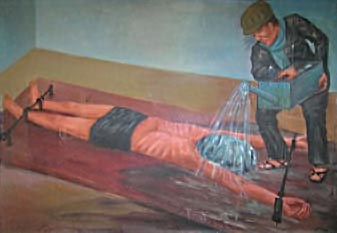 One of the most irritating aspects of the Mr. Bush's administration (aside from all the other irritating aspects) is the insistence that the interrogation technique that America condemned when it was used by the Khmer Rouge - namely, water boarding - is now not only legal, but absolutely necessary to conduct the "War on Terror" ("War of Terror" might be more apt). With the wingnuts and Administration officials screeching about the "Ticking Bomb" scenario, many people also buy into the idea.
The are a number of problems with Mr. Bush's recent veto of a bill that would prevent the CIA and other groups from using water-boarding and other torture techniques.
First and foremost, waterboarding IS torture. The Japanese and Gestapo used the technique in World War II. And early form of it was used during the Spanish Inquisition. Most famously, it was used by Pol Pot's Khmer Rouge. US troops used it in Vietnam, but they did so illegally - during that other failed act of aggression 40 years ago, the generals designated the technique illegal.
Which brings me to the next point. Not only is waterboarding torture - and thus illegal under the Geneva Convention - but it is also illegal under US law. The fact that Mr. Bush has made it
legal by fiat - presidential signing statements and executive orders - shows how little respect he has for the Constitution and seperation of powers. Perhaps he never saw School House Roch as a child, but only Congress can make the laws, and the President cannot enact a line-item veto, which is effectively what his use of Presidential Signing Statements amount to. The truly egregious part is that he has not been hauled before Congress to at the least testify. We as a country have slowly moved from outrage over the actions of this Administration to apathy, as it becomes expected that the Executive can do whatever he or she pleases.
Thirdly, waterboarding and torture do not work. Let me repeat: waterboarding the torture do. not. work. People subjected to torture will say anything to have the torture stop, whether they know anything or now. Additionally, the "ticking bomb" scenario - the idea that we need to be able to torture, in case there is a bomb in a major city somewhere and the only choice is torture or destruction - is pure Hollywood fantasy. Such events might happen in 24, but in the real world they are not only unlikely - according to experts, "Ticking Bomb" scenarios are impossible.
Even if such a scenario were to occur, torture would not help. In order to obtain useful information from suspects, an interrogator needs to build a relationship with the suspect, which takes weeks. Psychological attacks work much more effectively than physical abuse.
The list could go on. The fact remains that Mr. Bush cannot veto a bill banning waterboarding because waterboarding is already illegal and immoral. The bill should never have gone through Congress in the first place: they had already passed an anti-torture bill a few years ago. What Congress should have done was object to Mr. Bush's signing statement on that bill - which effectively turned a bill designed to close loopholes into a massive loophole on the question of torture.
However, the political ramifications of this act - if it is properly publicized - could be enormous. While the Republicans will couch the veto in the language of National Security, the Democrats - if they are clever - will beat the Republicans over the head with this veto. I am no fan of the Democrats, mind you. I just desire some remuneration for what will be 8 long years of law breaking, illegal war, and the erosion of the economy. I say, send the war criminals off to the Hauge and let them answer for their crimes before the international community.
Friday, March 7, 2008
So it begins again
The BBC has reported today that a station commander in Britain suggested that members of the RAF not wear their uniforms in public because of verbal abuse from people opposed to the Britain's involvement in the wars in Iraq and Afghanistan.
Slowly, then we can see the resurgence of the Vietnam myth: that antiwar activists hate the troops, that we spit on them or deride them, or verbally abuse them. Antiwar individuals run the gamut in their opinion about the troops, or the army, but on the whole the antiwar movement is, and has been, incredibly supportive of individual soldiers (especially veterans) while at the same time being incredibly critical of the system that creates soldiers - a position that is in no way contradictory.
We stage counter-recruitment events not out of a hatred of the troops, but out of a hatred of the war and the current Army, and out of a desire to keep more young men and women from the trials and tribulations of armed service.
 This particular incident strikes a chord with me, based on an event that happened just yesterday while on the Quad, tabling for our Week of Action. An individual began a heated debate with us about how he had family over in Iraq, and how what we were doing was disgraceful. In his mind, antiwar activists since Vietnam have opposed the troops, and the troops have in turn opposed the antiwar community. While debating individuals can be cathartic and fun, it also does tend to reflect poorly on us when we are tabling. Shouting at people on the Quad makes us seem quite hostile, more radical than we are, and frankly, unapproachable and unfriendly. People like that will not be swayed in the two minutes we spend yelling at them, and in that time we may very well loose others who might have come out. I am not, of course, saying that we should not have civil discussions with people with whom we disagree, and I fully expect shouting to be a part of that. But when we table, I feel that discussions should try to be as civil as possible.
The idea that the antiwar community and the community of active and veteran soldiers are set at odds is, of course, a falacy, but one which unfortunately continues to exist. Education is the best way to combat this issue. By working closely with IVAW, we are able to show people that the antiwar community respects the veterans. By counter-recruiting, the antiwar community shows that it respects and values lives more than the Army does. By showing educational films - such as Sir! No Sir! and The Ground Truth - the antiwar community is able to show that we have a history of supporting the veterans and the troops, and that the myth of spitting on vets is just that - a myth.
A number of weeks ago, a fellow student told me that he really supported a sign that I had in my window for some time: "Support the Troops, Bring Them Home." He, like many others, has been taught only the myths of the antiwar movement, and he told me that the sign showed him that on the whole the antiwar movement is made up of normal people, and not fringe radicals.
Now, I won't say that such "verbal abuse" never happens, nor will I say that it never will happen. However, happily Brown's government has come out decrying this claim as rediculous, and the report mentions that no reports of such actions have been filed.
We must all be active in our rejection of the myth of the antiwar movement as a movement that is also opposed to the veterans, both in our words and in our actions.
Slowly, then we can see the resurgence of the Vietnam myth: that antiwar activists hate the troops, that we spit on them or deride them, or verbally abuse them. Antiwar individuals run the gamut in their opinion about the troops, or the army, but on the whole the antiwar movement is, and has been, incredibly supportive of individual soldiers (especially veterans) while at the same time being incredibly critical of the system that creates soldiers - a position that is in no way contradictory.
We stage counter-recruitment events not out of a hatred of the troops, but out of a hatred of the war and the current Army, and out of a desire to keep more young men and women from the trials and tribulations of armed service.
 This particular incident strikes a chord with me, based on an event that happened just yesterday while on the Quad, tabling for our Week of Action. An individual began a heated debate with us about how he had family over in Iraq, and how what we were doing was disgraceful. In his mind, antiwar activists since Vietnam have opposed the troops, and the troops have in turn opposed the antiwar community. While debating individuals can be cathartic and fun, it also does tend to reflect poorly on us when we are tabling. Shouting at people on the Quad makes us seem quite hostile, more radical than we are, and frankly, unapproachable and unfriendly. People like that will not be swayed in the two minutes we spend yelling at them, and in that time we may very well loose others who might have come out. I am not, of course, saying that we should not have civil discussions with people with whom we disagree, and I fully expect shouting to be a part of that. But when we table, I feel that discussions should try to be as civil as possible.
The idea that the antiwar community and the community of active and veteran soldiers are set at odds is, of course, a falacy, but one which unfortunately continues to exist. Education is the best way to combat this issue. By working closely with IVAW, we are able to show people that the antiwar community respects the veterans. By counter-recruiting, the antiwar community shows that it respects and values lives more than the Army does. By showing educational films - such as Sir! No Sir! and The Ground Truth - the antiwar community is able to show that we have a history of supporting the veterans and the troops, and that the myth of spitting on vets is just that - a myth.
A number of weeks ago, a fellow student told me that he really supported a sign that I had in my window for some time: "Support the Troops, Bring Them Home." He, like many others, has been taught only the myths of the antiwar movement, and he told me that the sign showed him that on the whole the antiwar movement is made up of normal people, and not fringe radicals.
Now, I won't say that such "verbal abuse" never happens, nor will I say that it never will happen. However, happily Brown's government has come out decrying this claim as rediculous, and the report mentions that no reports of such actions have been filed.
We must all be active in our rejection of the myth of the antiwar movement as a movement that is also opposed to the veterans, both in our words and in our actions.
Subscribe to:
Posts (Atom)
.png)